Powered By Blogger

Thursday, 31 May 2012

How to plan a herb garden


A herb garden will provide you with fresh herbs for culinary or medicinal purposes all year round. But if you do not want, or do not have sufficient space, for a herb garden you can grow herbs in containers or in existing vegetable or flower beds.

If you have sufficient space, here are some ideas on how to create a  practical herb garden. Start with a sunny but sheltered spot which is preferably near the kitchen, so that when cooking you can easily pick herbs to use fresh out of the garden. 

Many herbs originate from the Mediterranean area and will do well in rocky, relatively dry soil, remember that they evolved in conditions of good drainage. This means that they do need some water, but the soil should be moist not wet. So while soil preparation is minimal it is not non-existent, a mix of sandy loam and clay or a good compost will support a good range of herbs, but it must be well drained.

Designing yourself a herb garden is a simple task. Start by measuring the space available and making different plans of assorted shapes until you have a few good ideas to work with. Simple forms such as square, triangles, circles or half-circles are a great way to begin a structure to plant your herbs. The design options are entirely up to you, draw a plan of the space available and get designing but take into consideration the number of herbs and relative size of the herbs you want to grow and their accessibility. You might also want to incorporate paths which can be paved with bricks, stones or even old wood to make access easier and add some charm to your herb bed.

Obviously the choice of herbs depends on your personal tastes, whether you want them for cooking, cosmetics, fragrance or medicinal purposes, but these are our favourites (in no particular order): 

Annuals - parsley, coriander, basil, aniseed, rocket and summer purslane.

Perennials - bay, rosemary, mint, sage, oregano, thyme, lavender, chamomile, chives and fennel

For detailed advice on how to grow and care for the herbs of your choice go to http://sites.google.com/site/cyprusgardener/home/herbs

If the herbs you want to grow are annual and you want to grow a large quantity to harvest and dry at the end of the season then you can make additional plantings anywhere in the garden. In fact, these can be incorporated into your vegetable beds, as herbs such as basil, coriander and dill, will attract beneficial insects which can help with pest control.

Culinary herbs, that are perennial, might not take as much space since you cut only what you need and a few plants should be enough to see you through the season and can be placed in a more permanent bed. Use the space you have available to grow the herbs you find most useful. Another consideration is if you are growing certain herbs for pot pourri or dyes, you will need a much larger space. 

It's important to plan the distribution of you herbs from the beginning. When growing, various herbs will take different forms. Some herbs grows thick but short in height while others are long and lean. Certain herbs have the tendency to grow and crawl about and can even behave like vines. This unstructured mixture can seem totally out of control especially during their peak season of May through June. 

Ten uses for the herb rosemary

We have some well established rosemary bushes growing but we are not using as much as we should. So we thought it would be useful to make a list of its many uses. A list which will remind us what we should be using our rosemary for.

1.   Make a rosemary mouthwash - http://cyprusgardener.blogspot.com/2011/09/make-your-own-herbal-mouthwash.html

2.   Use a disinfectant - simmer leaves and stems of rosemary, sage and lavender in just sufficient water to cover for 25 minutes. Once cool, strain, bottle and use to wipe over sinks, toilets and baths to provide a fresh scent.

3.   Make flavoured oil or vinegar, infuse rosemary in a bottle of olive oil or vinegar, for 6-8 weeks, to flavour .

4.   Add rosemary flowers to sorbets or dressings to add a mild rosemary flavour.

5.   Make rosemary tea which is said to be good for digestive problems.

6.   Soak and use tougher stems for BBQ skewers

7  . Make an infusion with two tablespoons of dried rosemary added to one cup of boiling water. Leave for      ten minutes and use as a hair tonic, after shampooing, to help treat dandruff.

8.   Add to roasting vegetables, rice, pizzas, fish, lamb, chicken and when baking bread.

9.   Add to a hot bath to aid aches and muscle fatigue.

10. Add to soups and stews.

Tuesday, 29 May 2012

Make Your Own Mulberry Jam

A jam to make when mulberries are season, which is from May to June in Cyprus and is delicious mixed in porridge on a cold winters day.

Ingredients needed are: 2.75kg of either white, red or a mixture of mulberries; 1 green apple or home made pectin, 100ml of water; 50ml of freshly squeezed lemon juice and 1.4kg of sugar

If you would like to make your own apple pectin use the following link - (http://cyprusgardener.blogspot.com/2011/06/making-your-own-apple-pectin.html)

Wash the mulberries, chop the apple very finely (the apple is not needed if you are using your own homemade pectin). Place the mulberries and chopped apple in a large bottomed pan and add the water, lemon juice and half the sugar. Gradually heat whilst stirring continuously until the mixture releases sufficient liquid and the sugar dissolves. 

Turn up the heat, add the remaining sugar, and continue stirring until the mixture boils. Boil hard for at least 15-20 minutes and check for setting by placing a small amount of jam on a cold saucer and after a minute check to see if a skin has formed. Continue boiling and checking until a skin forms on the tested jam.

Once a skin is apparent, turn off the heat and pour the jam into cleaned and sterilised jars. Once cooled, keep in a cool and dark place and your mulberry jam will keep until mulberries are ready again the following year to make another batch.

Mulberry Bush Fruit

Mulberries are now in season and we have recently tasted both white and red. White mulberries are very sweet and have a honeyish taste whilst the red are less sweet and taste something between a raspberry and blackberry. Once picked the fruit does not keep very well and is best used within a couple of days.

We have planted two mulberries which have yet to fruit. One was a very small tree which was growing in the same pot as a purchased plum tree. After three years it has reached a good size and will hopefully fruit next year. The other was dug up from a stream bed and it larger but to our disappointment we now suspect it's a male tree which will never fruit. We are considering whether to graft a female onto it or dig it up and replace with a fruiting mulberry.

Mulberries are quite drought tolerant, will grow in most soils and enjoy a position with full sun. Other than providing some fertilizer during the winter and mulching in the spring, mulberries require very little care and are not bothered by many pests or diseases. Pruning is only required to retain a desired shape and to remove any damaged wood and this should be carried out in mid-winter.

Mulberry fruit not only tastes good, it's nutritionally an excellent source of vitamins and minerals and is also useful for baking, juicing and makes a lovely jam. Mulberries can be sun dried and used instead of raisins when baking muffins or cakes.

Saturday, 26 May 2012

Herb Garden

Just spent two days re-edging the herb garden beds. The winter and spring rains washed away the edging and compacted the soil which needed breaking-up. Establishing plants has been slow with some adapting quickly to the soil and climate and others dying after one hot summer.

Looking back at our original plan we had listed 50 herbs to grow but have so far managed to establish around 20 but we are adding more every year and are on the lookout for varieties suitable to the Mediterranean climate.

We plant some annual herbs monthly to ensure a continual supply of coriander, parsley and rocket. The basil is started early in the propagator and we plant plenty to permit us to dry enough to keep us going until the next planting.

Perennial herbs which have done well include chamomile, chives, comfrey, fennel, garlic (we use the tops and allow the bulbs to re-germinate every year), lavender, various mints, oregano, rosemary, sage and.lemon balm. And our bay tree is now getting to a decent enough height where we no longer feel guilty removing a few leaves.

We have self-seeding marigold, linseed, poppies and dill. To fill gaps we sow sunflowers and have two large areas of Jerusalem artichokes which, if we can as they are notoriously difficult to clear completely, we will re-locate when other herbs are available to fill the space.

Friday, 25 May 2012

Cypriot Koulouri or circular sesame seeded bread

Koulouri is a traditional Cypriot circular bread, with a hole in the middle, and is coated with sesame seeds. Cypriot koulouri tends to have a crunchy or even hard coating, in comparison to similar breads in the region which are often softer. There are many different village recipes and in various combinations some may also include cumin, anise, fennel or caraway seeds. Cypriot bread was, and in some cases still is, traditionally made using a sourdough starter and baked in an earth oven. Cyprus has for centuries had a reputation for it's bread making, as the ancient writer Ebulus wrote in the Middle Ages, "Tis a hard thing, beholding Cyprian loaves, to ride carelessly by, for like a magnet, they do attract the hungry passengers".

Have a try at making your own koulouri, using the following basic recipe which can be baked in a kitchen oven and you will enjoy the aroma that will fill your kitchen.

Ingredients:

150g sourdough starter or 1.5 Tbs of dried yeast
850 grams of flour
2 tsp salt
2 Tbs of crushed anise seeds
3 Tbs of sugar
1-2 cups of water
50 ml of olive oil
250g-350g sesame seeds

Method

If using dried yeast this needs to be activated as per the instructions.

Sift 850 grams of flour into a bowl and add the salt. Make a well in the center and add the sugar, anise seeds, olive oil and sourdough or activated yeast. Mix in well, start kneading by continually adding sufficient warm water to form a dough. You may need to add a bit more flour to get your dough to the right consistency.

Place the dough in a bowl, cover with a cloth and leave until it has doubled in size. This, depending on the temperature, will take from between one to two hours.

Re-knead for another 5 minutes. Divide the dough into 15-20 or so portions and roll them into thin sausage shape, about 35 cm in length. Dip these in warmish water and roll them in sesame seeds before pressing the 2 ends firmly together to form a ring.

Preheat the oven to 220C, lay the sesame rings on a baking sheet and bake for 20-25 minutes, until golden brown on the outside.

Your koulouri can be enjoyed either warm or cold and in Cyprus is traditionally accompanied by olives and halloumi or hellim cheese.

Thursday, 17 May 2012

Collecting poppy seeds

One of our vegetable beds has been covered in poppies this year. Rather than dig these up, we have let them ripen to collect the poppy seeds which we use when bread or roll making to add a crunchy and nutty flavour.

The seeds are ready for collection when the head turns from green to brown to signify the seed head has dried. We have previously collected seed by shaking each individual head into a jar but this is very time consuming.

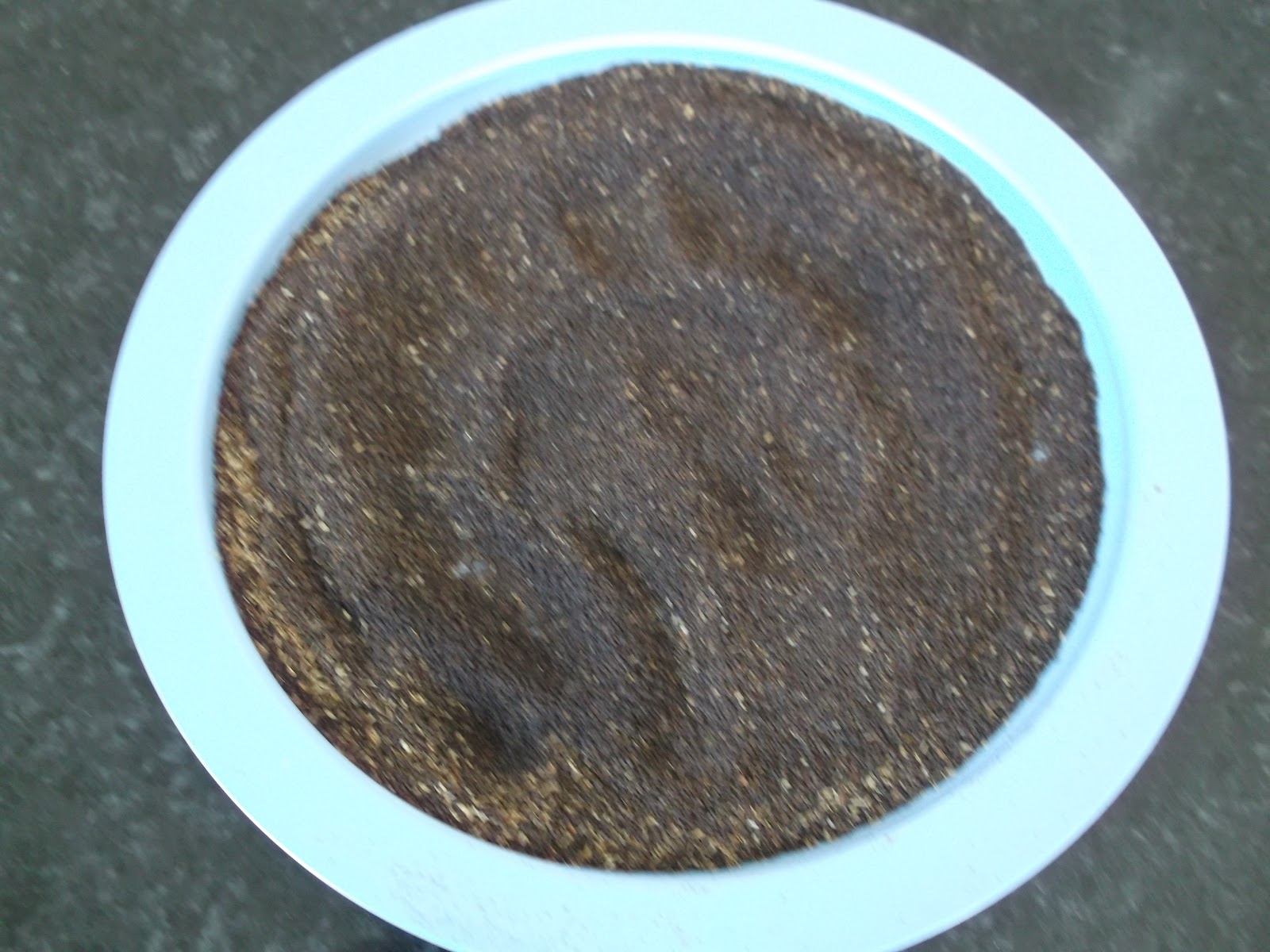
This time we cut off the heads and collected them in a bowl. Placed the heads on a tea towel, crushed them with a rolling pin to release the poppy seeds and sieved them to remove any bits of husk. The process worked quite well, using a large holed sieve and then one with a much smaller gauged holes to remove smaller bits of husk. Any collected poppy seeds should be stored in a sterilised airtight jar in the fridge and used within 6 months.

Poppy seeds are tiny and 600g contains about 1 million seeds but the seeds are rich in minerals which include iron and calcium. These seeds have been used for centuries for their medicinal value and are used in cough syrup preparations and to treat insomnia.

People often worry about using poppy seeds because of their narcotic properties but ripe poppy seeds only contain minute amounts, hardly traceable, of morphine and codeine.